CL 9/26

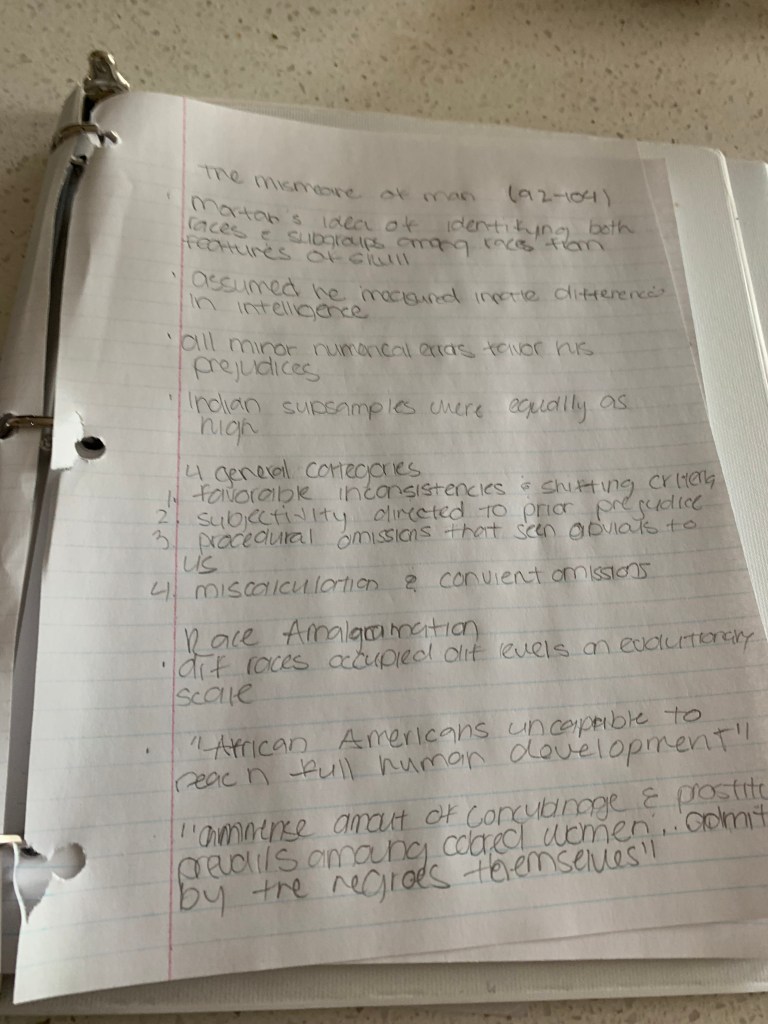
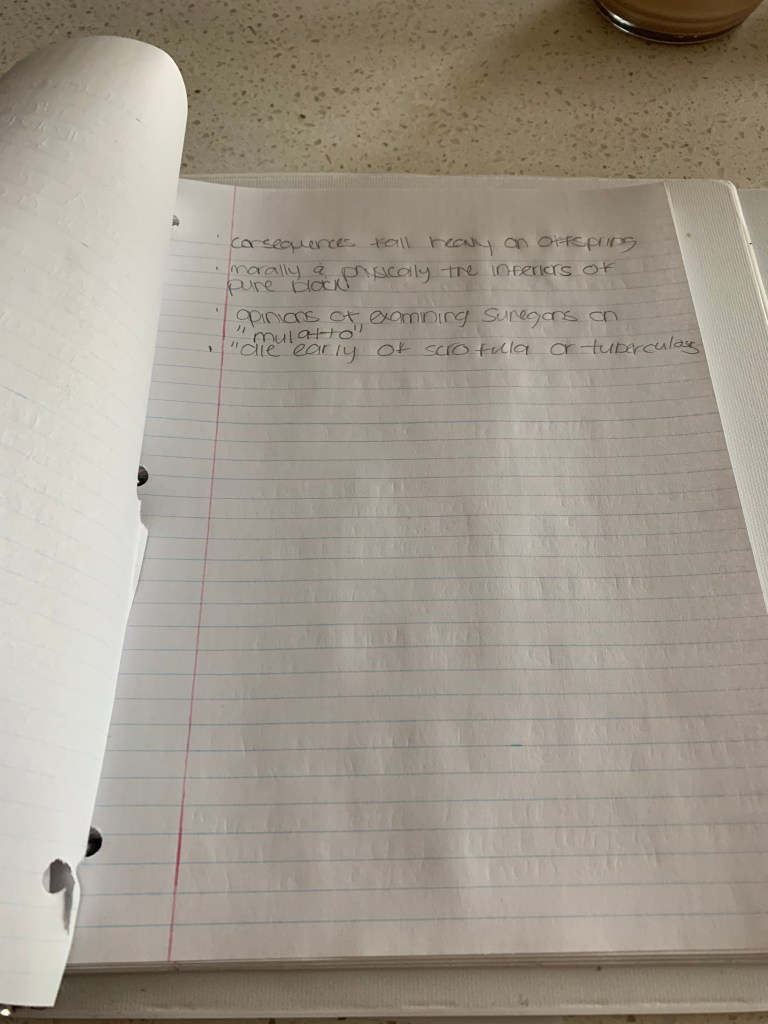
In your own words, explain why Stephen Jay Gould believes that Samuel Morton’s work was not a case of conscious fraud (bottom of page 86 through page 88–there are a bunch of data tables on these pages so don’t think the task of finding the answer is too onerous)? Gould states that he does not believe Morton’s work to be a case of conscious fraud because, “He would not have published his date so openly”. He also says that conscious fraud is very rare in science, for the simple fact that it’s not interesting and tells little of the nature of scientific activity. Along with the fact that, if you can find prejudice in Morton’s work, you can find it in anything else.

  • Claim–what is the writer’s thesis statement? Those of African ancestry are naturally inferior to whites.
  • Reasons– a reason the writer provides that his thesis statement is true or at least valid. God created the differences between the races, therefore the natural creator made it this way.
  • Evidence– the testimony of experts; summary/paraphrasing/direct quotation of reputable source that studies the issue at hand; the presentation of data from an empirical study; anecdotal (not systematic or rigorously recorded) observations that backs a reason you (as the analyst) have called out. One piece of evidence is slavery being rudimentary condition. Another piece of evidence he declares is that it would be unnatural for African Americans to have similar rights to the white man. He uses the idea that if African Americans can vote, they will act out of resentment.
  • Warrant– the unstated belief/values that tie the reason and evidence combo to the claim The belief that God created the inferior race to assist and be a leverage for the more superior white man
  • Counterargument–the presentation of the writer’s opponent’s argument The idea of prejudice being irrelevant because Morgan says its always been this way and it’s the right way.
  • Rebuttal– the writer explaining the flaws in her/his opponent’s argument Morgan basically says that it would be unnatural for African Americans to be held to the same respect and power as whites, therefore it’s wrong. He always uses fear to convince readers that if African American’s have these rights, they will ruin the country.

The intended audience would be people that John Morgan can convince about the quality of African Americans and voters. The Gap of ‘The Race Question’ is coming to the conclusion of African Americans being inferior to Whites. Morgan’s purpose for his piece is to get voters on his side. Morgan uses fear as his rhetorical appeal to persuade readers into taking his side on the issue.
CL 9/24

  • Prompt one: In your opinion, how do the activities of the individuals discussed in last night’s reading match Swales’s benchmarks for a discourse community?
    • I recommend you look over the six criteria Swales lists in his essay (pages 471-473).
    • You can focus on one, two, or all six of the benchmarks for your answer.
    • The discourse community uses its participatory mechanisms primarily to provide information and feedback. In PVF, a lot of information about the laws and their nature is talked about. The information given is there to provide the reader with a set of laws and what was going on at the time of the case, along with some background info that helps get a conclusion of the case. This gives the reader something to go off and form more opinions around. The information can be used to bring people together and form more like minded ideas to go off of.
  • Prompt two: Based on your understanding of the reading you choose to write about in the question above, how did this discourse community spread the “knowledge” they were responsible for creating? The discourse community was able to spread the knowledge by news. The magnitude of this case pulled in people who sided with that particular side and give them more information so they feel like they are diving deeper into the issue. All the background and information about laws, what was going on at the time gave people a reason to invest in the case and continue to build their opinion.
  • Prompt three: How do you think the thinking/writing/talking (the discourse) of the special interest group you choose to write about set the foundation for American Jim Crow laws? I think the foundation of Jim Crow laws were given the chance to take place in history because so many people agreed with what was being said about African Americans and their rights, even if it was outwardly wrong and unfair. What we read in PVF gave so much logical info and used its information to twist the story into what some people wanted to hear and make it sound right. With bringing up law and what’s seen as right from wrong, it allowed those who had a certain assumption and to justify their opinion and have a basis to go off of.

CL 9/19

The Mismeasure of Man

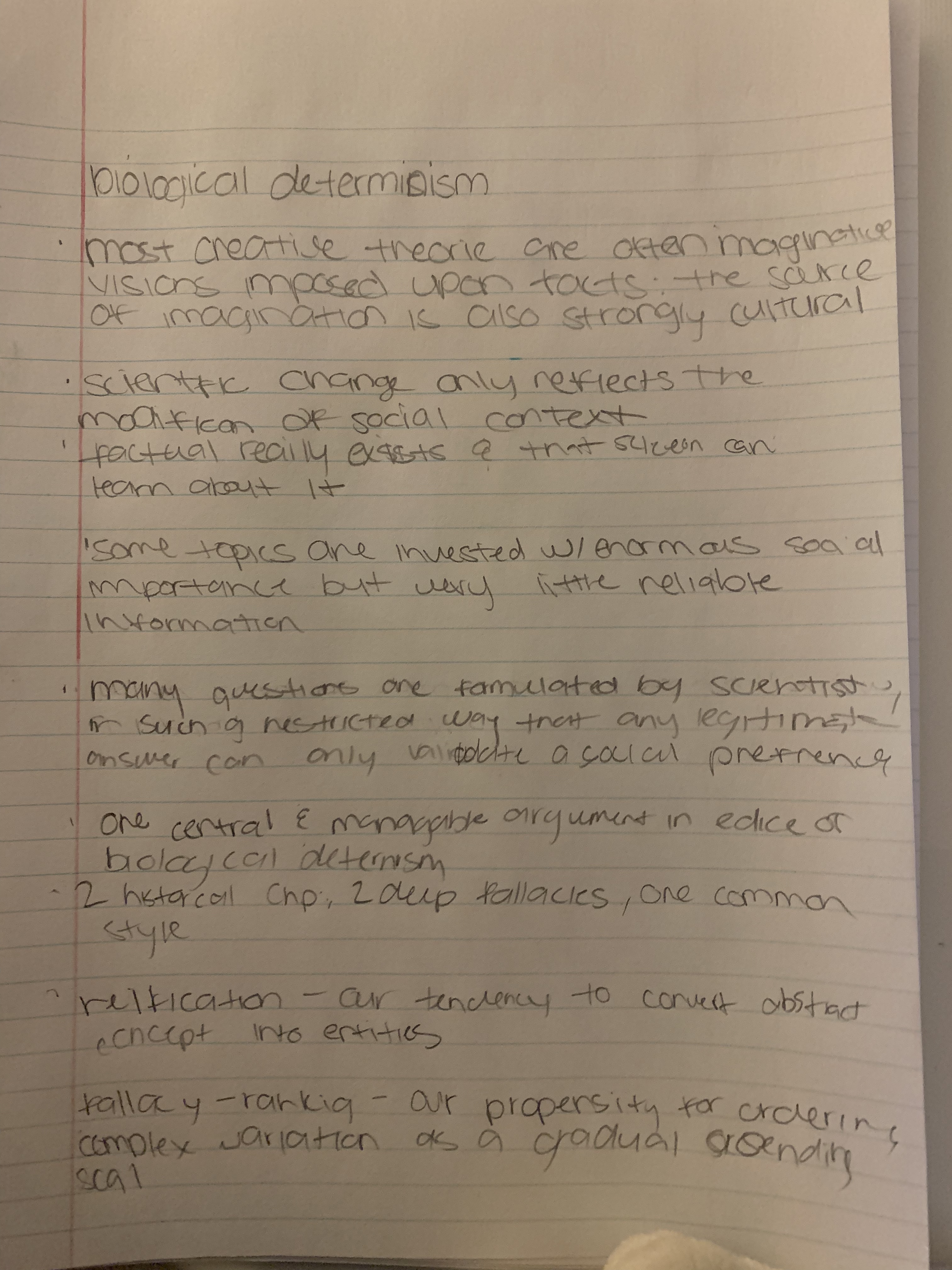
  1. How does Gould define biological determinism? (page 52) The claim that worth can be assigned to individuals and groups by measuring intelligence as a single quantity.
  2. What are the two major sources of data that have supported this theme known as biological determinism? (page 52) craniometry and certain styles of psychological testing
  3. What have biological determinists invoked when it comes to the issue of race? (page 52) A traditional prestige of science of objective knowledge, free from social and political taint
  4. According to Gould on page 53, biological determinism is useful for:
    1. Groups in power
    2. Groups not in power
  5. According to Gould on page 53, for the adherents of biological determinism, changes to a social and political system based on a racial caste system seen as an extension of nature is:
    1. Inconsequential
    2. an enormous costs for individuals psychologically
    3. an enormous costs for society economically
    4. Both B) and C)
  6. Gould’s arguments against biological determinism begin by attacking which two fallacies? (page 56)
    1. Reification and ranking
    2. Geocentrism
  7. In the last paragraph of page 56, what does Gould write is his book is about (his explanation continues onto page 57)? The book is about abstraction of intelligence as a single entity, its location within the brain, its qualification as 1 number for each individual, and use of numbers to rank people in a single series of worthiness
  8. Finish this sentence, which can be found on page 59: “In most cases discussed in this book, we can be fairly certain that biases—though often expressed as egregiously as in cases of fraud—were unknowingly influential and that scientists believed they were pursuing unsullied truth
  9. On page 60, Gould describes biological determinism as a theory of limits. What does he mean by that? few biological subjects have had a more direct influence upon millions/ it takes the current status of groups as a measure of where they should and must be

Plessy v. Ferguson: A Brief History with Documents

  1. According to Brook Thomas, the editor of Plessy v. Ferguson: A Brief History with Documents, what were the problems with laws designed to keep races separate (hint: it deals with the concept of skin color and “passing”)? (page 3) They were designed to keep races separate but widespread racial mixture played havoc with efforts to divide the population into pyre black and white categories. “separate but equal” but were rarely equal
  2. What did Albion Tourgee want the Supreme Court to do when it came to segregation laws? (page 4) he wanted o test the case of someone with mixed blood to violate the law and he wanted a legal challenge
  3. Why was Homer Plessy chosen as a test case? (page 4) He was 1/8 African american and according to counsel, “the mixture was not discernible”
  4. Why did Justice John Ferguson rule in favor of Daniel F. Desdunes riding a train over state lines but against Homer Plessy, who rode a train within the borders of Louisiana? (page 5) Ferguson ruled that the law was unconstitutional on interstate trains b/c of the federal governments power to regulate interstate commerce
  5. What is the difference between a social right, a political right, and a civil right? (page 12) Political rights are the rights we have in relationship to the political entity that governs us, civil rights are the nonpolitical rights of citizens of particular country and tend to occur a middle ground between political and social rights. Social rights are not rights in relation to governing body but in relation to other human beings in society.
  6. Why does Congress pass a civil rights act? (page 13) It decides that some social rights are so important that they should receive legal protection.
  7. According to Charles Walter Collins, what did the 14th Amendment do? (page 14)
  8. Which group was the first to bring a case before the Supreme Court citing a violation of their rights under the 13th and 14th Amendments (hint: it wasn’t African Americans)? (page 18.)

CL 9/12

  1. How does Swales explain what he means when he writes that speech communities are centripetal while discourse communities are centrifugal? (471) When Swales says that speech communities are centripetal, he’s explaining that they absorb people in a more general way. Speech community draws people in and its inherited by birth, accident or adoption. Discourse communities are centrifugal because they can separate into occupational/special-interest groups. Discourse communities push people apart from their previous speech community based on goals or occupation.  
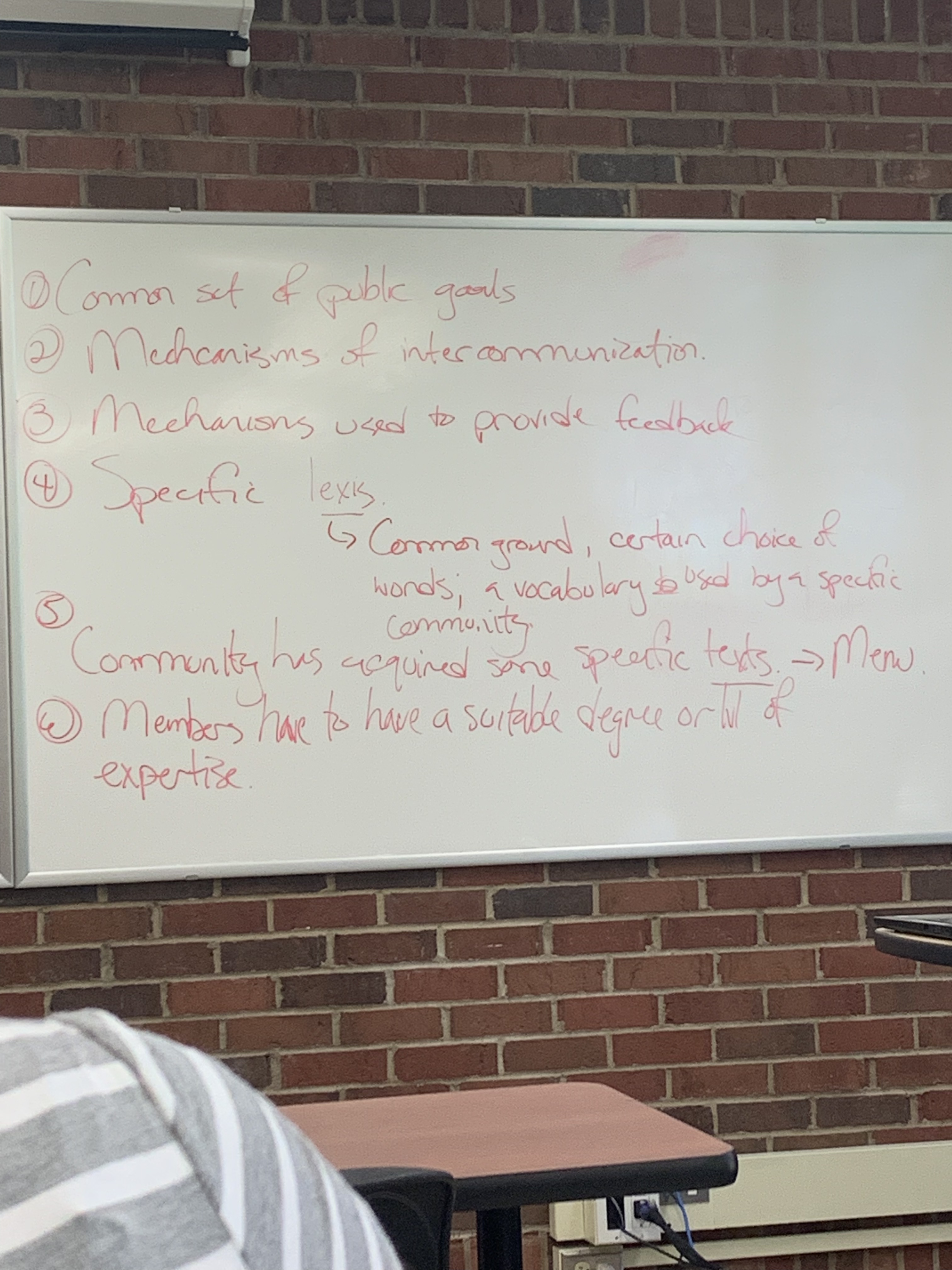
  2. According to Swales, what are the six defining characteristics of a discourse community? (471-473) 1. Discourse communities has a broadly agreed set of common public goals. 2. It has mechanisms of intercommunication among its members. 3 Discourse uses mechanisms to provide information or feedback. 4. It utilizes & posses 1 or more genre’s in the communicative furtherance of its aim. 5. In addition to genres, it’s acquired specific lexis or common ground/vocabulary6. Has threshold level of members with suitable degree of relevant content and expertise.
  3. In your own words, what does Swales point out as the problems of the concept of discourse community? (478) It can have some contradiction if you don’t have enough evidence to prove a lexis exists . Another problem is that it can be removed from reality. People inside the community might not see reality beyond their designated bubble. Not everyone has the common goal, splits can happen because of this.
  1. The gap in this conversation is to get people to participate in this conversation about the nature of discourse communities/how it evolves. Along with recognizing the differences between discourse and speech communities.
  2. This piece fills the gap by explaining the differences between a speech community and discourse community in depth. Not only by definition but what takes place in these communities, how they work, and the nature of each type of communication between its members.
  3. The audience for this piece is aimed at higher level English teachers, aka his own discourse community.
  4. The danger of an essay like this is that it’s aimed towards a very audience.

HW 9/10

Reading “Learning to Serve” was cool for me because I work at a country club where I’m expected to be able to move from formal dining to the bar and then also in a more casual setting outside. Since we have many different areas at my job, I’ve had to change the way I interact with the members in each area I’m in. I really agree with the statement “there is complexity and skill required when waitressing” You have to be able to quickly understand what a customer is asking and wanting, then deliver. All while, appearing to be friendly, approachable and willing to provide a good experience for them. It took me a while to learn our menu because we use a lot of words and meaning that are in different languages or are higher level words. It takes a while to learn what the word “béchamel” is and when its used so when people ask you can apply it to what it comes in and where the word originates. Knowing where words come from help also explain the entire meal as a whole. There are major literacy and language skills needed to be a server, no matter where you may be serving. There’s more to it then the receptive and routine side of working in a restaurant. While it can be a lot of routine tasks, interactive servers have to have a least decent to good language skills when handling so many different types of customers. Not to mention when handling more high maintenance or difficult people. You learn as you go in serving positions and a lot of knowledge IS learned through experiencing specific situations, some are even more unpleasant than others. When customers have specific requests and questions, you are required to be able to provide answers and know how to deal with this requests. Not only does a server have to be able to provide answers to questions, but they also have to be effective when THEY are asking the questions. Lastly, being friendly in the restaurant business is a skill that requires some people to put more effort in. This is why the emotional labor of this job is considerable and should be recognized as such. Being able to be seen as approachable and friendly can be more difficult than it looks and requires some practice when you’re doing it all day, everyday at work.

CL 9/10

  1. How does Swales explain what he means when he writes that speech communities are centripetal while discourse communities are centrifugal? (471) When Swales says that speech communities are centripetal, he’s explaining that they absorb people in a more general way. Along with this, discourse communities are centrifugal because they can separate people into occupational/ speciality- interest groups.
  2. According to Swales, what are the six defining characteristics of a discourse community? (471-473) 1. Discourse communities has a broadly agreed set of common public goals. 2. It has mechanisms of intercommunication among its members. 3 Discourse uses its participatory mechanisms primary to provide information or feedback. 4. It utilizes & posses 1 or more genre’s in the communicative furtherance of its aim. 5. In addition to genres, it’s acquired specific lexis. 6. Has threshold level of members with suitable degree of relevant content and expertise.
  3. In your own words, what does Swales point out as the problems of the concept of discourse community? (478) It can have some contradiction.

CL 9/10

The issue- Ethics of administration in the White house

Reader- Time Subscribers (of people who keep up with current events)

  1. Here, let me recreate the scene, or rhetorical context, of the time period (I’m doing this for the purpose of the exercise, I do not have specific evidence to back this recreation). Let’s say in 2004 there was a larger, public-sphere conversation about the appropriate use of American military might and questions about the ethics of American corporations leveraging of individuals in the Bush administration for lucrative war time contracts. Time is a news magazine, and its regular readers are often seen as a group, or community, of informed, up-to-date-on-current-events type individuals.
    If we take this as true, in your own words describe what you think Stein sees as the gap in this conversation. In your opinion, how does this piece fill that gap? In my opinion, I think the gap is Stein’s attempt to make the reader see how they’re more drawn to the Yankee’s and what’s happening in baseball as opposed to what’s happening within our country. I think he was trying to show how it’s a joke. And topics like A-Rod and the Yankee’s aren’t really important right now.
  2. Go back to your answer for question three from CL 9/5. Do you still feel you made the correct choice? If not, feel free to change it. Looking back now, I think Stein was actually aiming at an audience that might not be taking the current events in our country serious enough. I could also see him aiming towards people who are a little naive and unaware.
  3. What’s the danger of an essay like this? The irony in Stein’s writing is the danger of this essay because some people (me) might have trouble understanding what he’s really getting at. Another danger of this essay is use of baseball and the Yankee’s to get his point across because it can throw the reader off and be distracting. Lastly, a major danger in this is the fact that some people might be offended.
  4. Let’s finish by writing a tentative claim about this article. Here’s a writing prompt to help you:What is the purpose of Stein’s challenging essay? Why are people in this country more interested and aware of what’s going on in baseball and A-Rod’s contracts than what just happened in the U.S and how we’re choosing to handle it?

HW 9/5

I have to admit, I found John Swales ‘Concept of Community Discourse” really hard to read and understand. I can’t say I enjoyed reading this but I can agree with the underlying fact that I believe there is a difference between speech communities and discourse communities. The first thing I noticed and was able to see the difference between the two was the fact that discourse communities are more so interest groups. While speech communities are seen as those who share ‘functional rules’. I also noted that speech communities tend to absorb people in general fabric and discourse communities separate into both occupational and special interest groups. Speech communities gain their groups by birth, accident or adoption. Discourse communities recruit members by persuasion, training or relevant qualifications.